Food & Beverage Automation
Food and beverage automation requires repeatable process sequences, controlled product routing, hygienic operating practices, traceable setpoints, and clear operator visibility. The automation system must coordinate tanks, pumps, valves, heating or cooling duties, dosing, mixing, transfer, cleaning, and utilities without losing the relationship between recipe intent and actual equipment state.
ECCT applies panel, PLC, HMI, instrumentation, and commissioning disciplines to process skids, syrup and preparation rooms, CIP systems, production-support utilities, and related treatment systems.
Process and Sequence Engineering
The control basis begins with the process flow, production stages, cleaning requirements, recipe or batch parameters, equipment capacities, valve matrix, transfer paths, and utility availability. Each sequence step needs defined entry conditions, active actions, target values, completion criteria, timeout response, and recovery behaviour.
A recipe should define only the parameters that are allowed to vary by product. Equipment protections, hygienic constraints, interlocks, and verified routing rules remain controlled by the automation design. Batch and sequence states are coordinated between the PLC and HMI so that operators can see the selected recipe, active step, target and actual values, hold conditions, and completion status.
CIP and Product Routing
CIP automation requires more than running pumps and valves for fixed times. The design may need to coordinate tank availability, supply and return routing, temperature, conductivity, flow, chemical concentration or dosing basis, circulation time, recovery, rinse confirmation, and safe transition between steps.
Valve command and feedback are treated as one function. A route should not be considered established only because open commands were issued; the required positions, pump permissives, and relevant process conditions must be proven. Timeout and mismatch conditions should hold or stop the sequence according to the approved philosophy and provide a clear operator message.
Where product and cleaning circuits share equipment, the control philosophy must prevent incompatible routes and define the conditions for returning equipment to production.
Panels, Drives, and Instrumentation
Process panels integrate motor feeders, VFDs or starters, PLC and remote I/O, analogue signals, valve interfaces, and communication networks. The design considers segregation, enclosure environment, washdown exposure where applicable, maintenance access, and the relationship between panel status and process availability.
Instrumentation may include level, flow, pressure, temperature, conductivity, valve feedback, and utility measurements. Range, hygienic connection, wetted materials, response time, mounting, scaling, and fail behaviour are reviewed in relation to the process duty. A conductivity or temperature value used to confirm a CIP transition requires different verification from a monitoring-only indication.
HMI, Reporting, and Verification
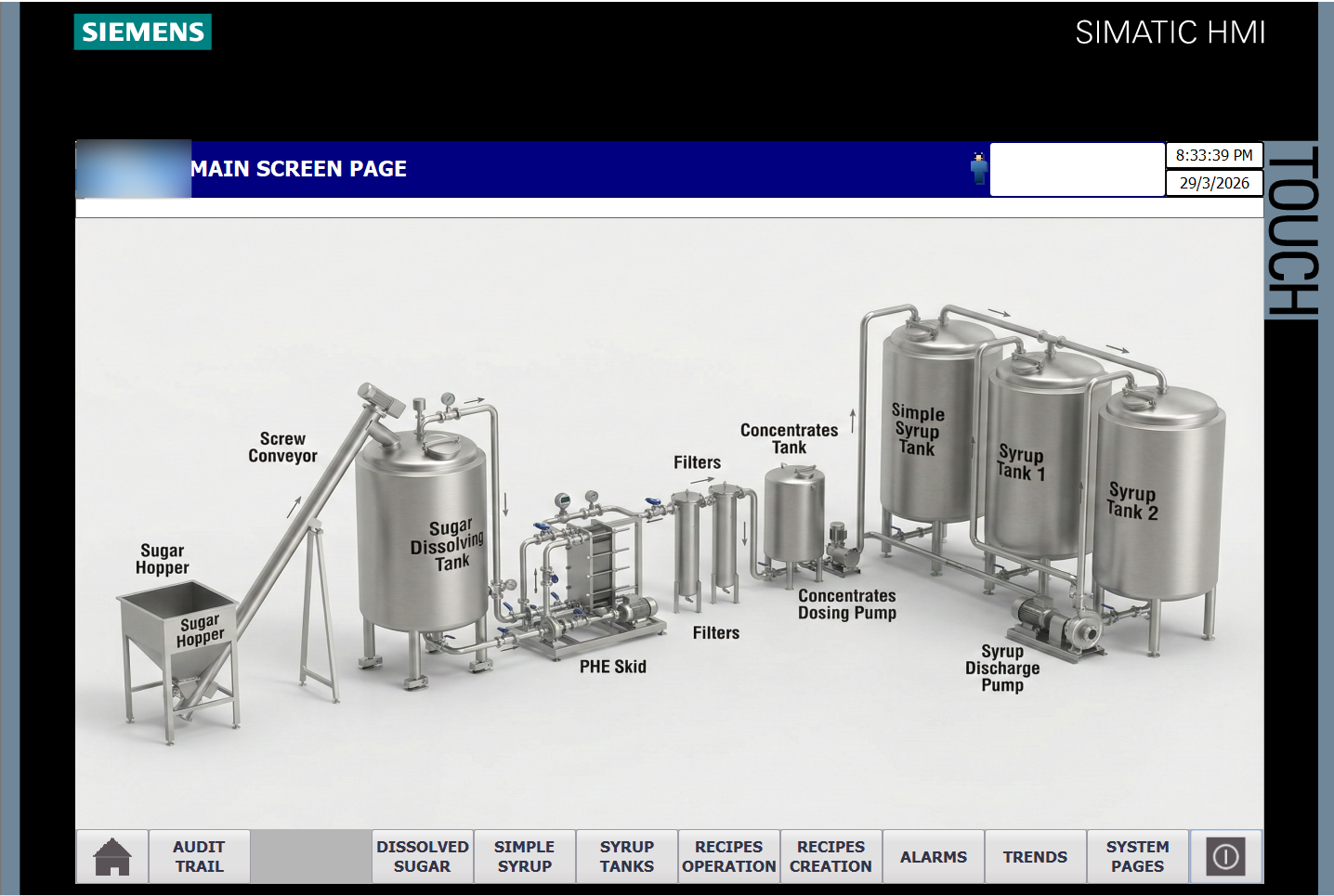
HMI screens follow the process and batch sequence. Operators need to see route status, active equipment, mode, permissives, interlocks, alarms, recipe values, and the reason a sequence is held. Manual functions are bounded by the approved protections and command-priority rules.
Where reporting is included, the recorded data should support the agreed operational need: batch start and finish, recipe, produced or transferred quantity, temperatures, conductivity transitions, alarms, or other approved values. Reports must use the same tag and unit basis as the control system.
FAT tests the sequence, route proof, equipment feedback, recipe limits, alarms, manual modes, and abnormal scenarios. Commissioning then confirms timing, process response, setpoints, and operator interaction under actual operating conditions.
Related Projects: Snack Land Syrup Room & CIP Room · Mix Tender Syrup Room Automation · Mix Tender Full Automatic CIP Unit · Heinz Factory Control Panel · Dohler Factory Process Skids · Coca-Cola Qaliob RO Plant 3 · Egypt Foods Plant Automation
Related Services: Control Panels & MCC · PLC, HMI & SCADA · Instrumentation